
Epsom Derby Forecast and Tricast Bets: How They Work and When They Pay
 Available in US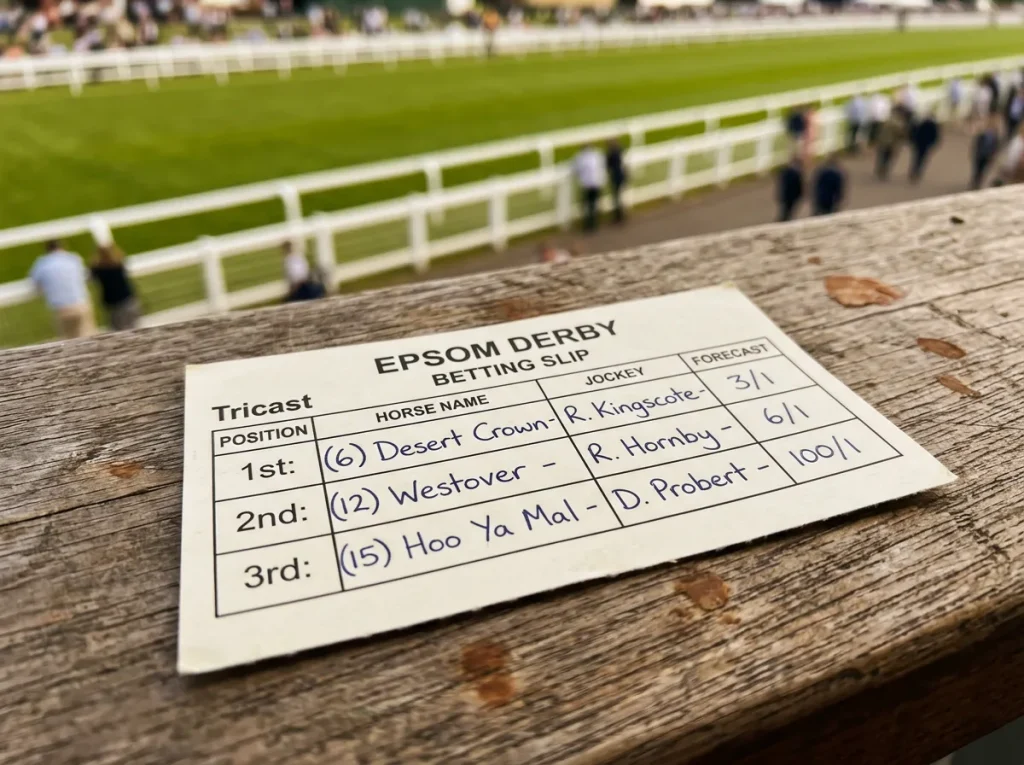
I backed a 7/1 second favourite to win the 2023 Derby outright and watched him finish a close second behind Auguste Rodin. The payout was zero. Had I placed a straight forecast instead – picking Auguste Rodin first and my selection second – the computer straight forecast would have returned more than a simple win bet on the favourite. That single race taught me something I now repeat to anyone who will listen: in a Classic where only three of the last ten favourites have obliged, exotic bets are not novelty add-ons. They are legitimate tools for extracting value from a race that routinely produces surprises.
Forecast and tricast bets ask you to predict the first two or first three finishers in correct order. The concept is simple enough, but the mechanics, the maths, and the tactical decisions around them deserve a proper look – especially when applied to a race as unpredictable as the Derby.
See also: epsom derby betting for forecast and tricast bet guides.
Straight and Reverse Forecast: Picking the First Two Home
A straight forecast requires you to name the first and second past the post, in the correct order. Get the order wrong and you lose, even if both your selections fill the first two places. A reverse forecast covers both permutations – your two selections finishing first and second in either order – but costs twice the stake because it is effectively two bets.
The returns on a computer straight forecast are not fixed at the time you place the bet. Instead, the industry uses a formula based on the starting prices of the two horses involved, the number of runners in the field, and a set of mathematical tables maintained by the Racing Post. This means your payout is determined after the race, which makes forecasts fundamentally different from standard fixed-odds win bets. You cannot know your exact return in advance, but you can estimate it by looking at current odds.
Take a hypothetical Derby field. If a 5/1 shot beats a 12/1 shot into second, the computer straight forecast will typically pay significantly more than a win single on the 5/1 selection alone. That premium is the reward for accepting additional difficulty – and in a race where the market leader has roughly a 30% strike rate over the past decade, this difficulty is less severe than it might appear. The favourite is failing to win seven times out of ten, which means forecasts involving non-favourites are landing more frequently than casual punters assume.
One practical consideration: most bookmakers require a minimum field size of three runners for forecast bets. The Derby, with its typical field of 12 to 18, easily qualifies, and the larger the field, the more generous the computer forecast payouts tend to be.
Tricast Bets: Adding a Third Selection to the Mix
The tricast extends the principle to the first three finishers in exact order. It is, in effect, a forecast on steroids – harder to land but with returns that can be genuinely eye-catching. I have seen Derby tricasts pay well into four figures from modest stakes, because the third horse in the frame is often a bigger price that inflates the payout dramatically.
Like forecasts, tricast dividends are calculated after the race using the computer tricast formula. The key variables remain the same: starting prices and field size. What changes is the exponential increase in difficulty. In a 16-runner Derby, the number of possible first-three combinations in exact order runs to 3,360. Your straight tricast covers exactly one of those outcomes.
That arithmetic looks daunting, but consider this: if you have strong views on three horses you believe will be involved in the finish, a small-stake tricast offers a level of reward that no combination of win and place singles can match. The Derby’s history of market shocks – winners at 40/1, 25/1, and 16/1 in recent years – means these outsider-heavy tricasts have paid out more often than the maths might suggest.
Combination Perms and What They Cost
Straight forecasts and tricasts demand exact finishing order, which is their weakness. Combination perms solve this by covering every possible arrangement of your selected horses across the relevant positions. A combination forecast on two horses costs only two unit stakes – identical to a reverse forecast. But a combination tricast on three horses covers all six possible finishing orders, so it costs six times your unit stake.
Where the costs escalate is when you add more selections. Include four horses in a combination tricast and you are covering 24 permutations. Five horses means 60. A unit stake of just two pounds on a five-horse combination tricast costs 120 pounds. That is a real outlay, and punters need to weigh it against realistic expectations. With the 2026 Derby purse sitting at two million pounds and attracting the strongest possible fields, a larger combination perm at least gives you broader coverage of a competitive race – but only if your unit stake is proportionate to your bankroll.
The smart approach is to keep your combination tight. Three or four horses in a tricast perm is the sweet spot for the Derby. Beyond that, the staking cost begins to erode the value advantage that drew you to exotic bets in the first place.
When Forecasts and Tricasts Pay Better Than Singles on the Derby
Not every race rewards exotic betting. Sprint handicaps with 20 runners and open form are chaotic enough that forecasts become lottery tickets. The Derby is different. Its field is smaller – typically 12 to 18 runners – and the form book, while imperfect, does narrow the realistic contenders to perhaps six or seven. That convergence of moderate field size and semi-predictable form is precisely the environment where forecasts and tricasts offer their best risk-to-reward ratio.
See also: Epsom Derby Each Way Betting to deepen your understanding.
There is a second angle worth considering. Because the Derby favourite has such a patchy record, the forecast and tricast dividends are frequently inflated by a longer-priced winner. A favourite finishing second behind a 10/1 shot produces a forecast dividend that dwarfs a win single on the 10/1 selection. You did not need to have the conviction to back the winner outright at those odds – you simply needed to identify that the favourite would fill a place and that a particular rival had the profile to beat it.
My rule of thumb: if I fancy two or three horses but cannot separate them with confidence, I move away from singles entirely and build a forecast or tricast perm instead. The Derby, where certainty is rare and class is tight, is exactly the race where that shift in approach earns its keep. For a broader view of the different wager types available on the Classic, the complete Epsom Derby betting guide covers the full range from straightforward singles through to specials.
