
Epsom Derby Race Day Guide 2026: From Final Declarations to the Last Furlong
 Available in US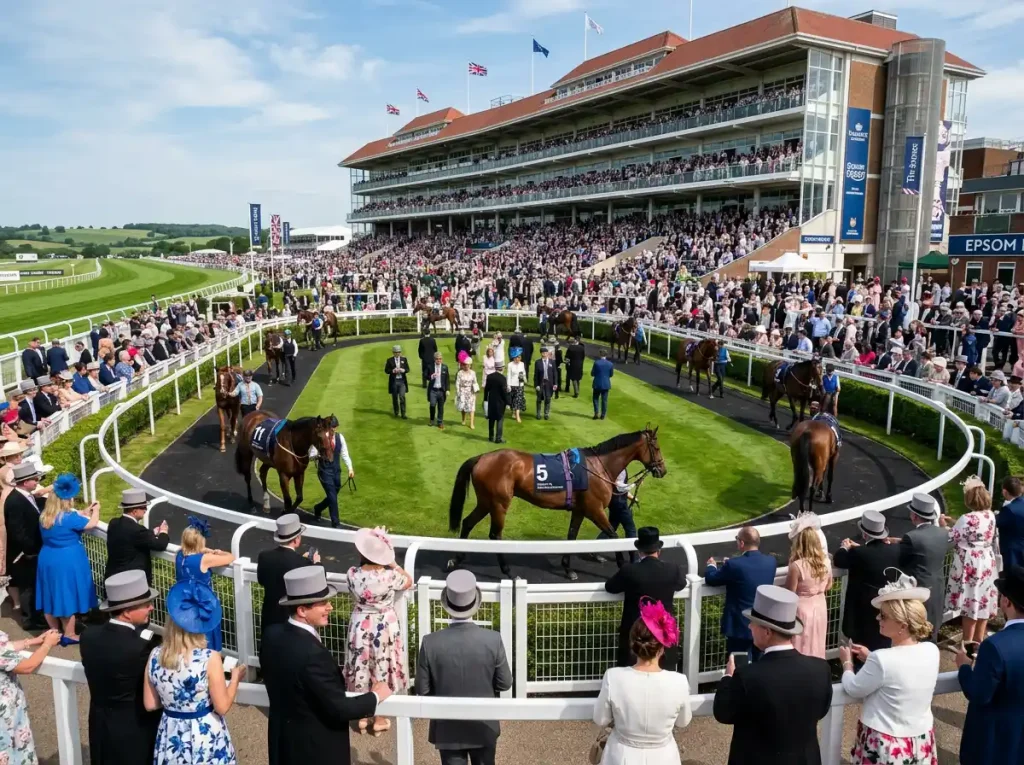
Derby day moves fast. By the time the stalls crash open at Epsom, the punter who has not done their homework is already behind. I learned this the hard way in my first year covering the race professionally: I arrived at the course with a shortlist, no schedule, no plan for how to handle late withdrawals, and no idea where to get reliable going updates. I backed a horse that had been scratched twenty minutes earlier. The bookmaker was kind enough to void the bet, but the embarrassment lasted longer than the race.
The 2026 Derby carries a purse of 2 million – 500,000 more than the previous year – and the expanded DerbyFest programme has added the Coronation Cup to the Saturday card, creating a twin Group 1 headline for the first time. The day is bigger, the schedule is fuller, and the opportunities to bet wisely (or waste money through poor timing) have multiplied. This guide gives you the hour-by-hour structure you need: from final declarations through to settled bets and any post-race enquiry.
See also: epsom derby betting for everything you need on race day.
Declarations, Withdrawals and How They Reshape the Market
The Derby’s declaration process unfolds in two stages, and each one can reshape the market. The initial entry stage happens weeks before the race, when connections pay a fee to keep their horse engaged. This creates a long list – sometimes 20 or more entries – that includes genuine contenders, speculative hopefuls, and horses whose connections are keeping their options open. The market at this stage is broad and the prices reflect uncertainty about who will actually run.
The critical moment is the five-day declaration stage. For the Derby, final declarations are made on the Tuesday before the Saturday race. This is when the field is confirmed, and the market instantly adjusts. Horses that were priced at 25/1 but had always been unlikely to run are removed, their implied probability redistributed across the remaining field. The entire shape of the market changes in minutes.
What to watch for at the declaration stage: the number of runners from each major stable, particularly Ballydoyle; any surprise entries supplemented late (the Derby allows supplementary entries for a fee, and these late additions sometimes signal a trainer’s confidence in a horse that was not originally in the race); and any withdrawals accompanied by statements from connections. A trainer who withdraws and says “we will wait for the St Leger” is telling you the horse stays but is not sharp enough for this test. A trainer who withdraws and says “we are bitterly disappointed” is telling you the horse had a genuine chance.
Between declarations and race day, the market evolves further. Overnight on the Friday, bookmakers issue their final pre-race prices. These reflect the declared field, the going report as of that afternoon, and any late intelligence. Then, from early Saturday morning, the race-day market opens and prices fluctuate continuously until the off. Each withdrawal between declaration and the off triggers a Rule 4 deduction on existing bets, which can affect your returns. Managing this process is not glamorous work, but it is the foundation on which race-day betting success is built.
The Full Derby Day Schedule and Supporting Races Worth Betting
The Derby is the centrepiece, but it is not the only race on the card. Derby Saturday at Epsom features a full programme of supporting races, and in 2026 the biggest addition is the Coronation Cup – a Group 1 race for older horses that has been moved to the Saturday card with its prize money increased from 450,000 to 1 million under Coolmore’s sponsorship. That gives the day two Group 1 races and creates opportunities for punters who think beyond the main event.
The supporting card typically includes a mix of handicaps and conditions races, ranging from competitive sprint handicaps to longer-distance events that attract horses with contrasting profiles to the Derby runners. These races serve a dual purpose for the prepared punter. First, they provide betting opportunities with potentially better value than the Derby itself, because the supporting races attract less public attention and the market is less efficient. Second, the earlier races on the card give you live information about the track conditions. How the ground is riding, whether the rail is a help or a hindrance, whether front-runners or closers are faring better on the day – all of this feeds directly into your Derby bet if you have the discipline to observe before committing.
My approach on Derby Saturday is to allocate my bankroll across the full card, not just the big race. I will typically place two or three bets on the supporting programme in the morning, using those races as both independent betting opportunities and information-gathering exercises. By the time the Derby field enters the parade ring, I have a feel for the track that no amount of pre-race research can replicate. The Coronation Cup in 2026 will likely run before the Derby and offers a high-quality data point: how Group 1 horses handle the conditions under race pressure, which can inform a last-minute adjustment to my Derby bet.
One word of caution: the supporting races are not warm-ups for your bankroll. Treating them as low-stakes appetisers before the main course is how people arrive at the Derby with a depleted betting fund and end up chasing losses on the biggest race of the day. Budget separately for the supporting card and the Derby. If the earlier races go badly, your Derby stake should be untouched.
Reading the Market in the Final Hour Before the Off
The final sixty minutes before the Derby is the most information-dense period in the betting calendar. Every signal that matters converges in this window: the going is confirmed, the paddock inspection is underway, jockeys are weighed out, and money is arriving in the market from every direction. Reading this flow correctly is the difference between a sharp bet and a panicked one.
Lambourn’s odds on the morning of the 2025 Derby shifted from 8/1 to 13/2 at the off – a steady contraction that reflected sustained support from informed punters. Meanwhile, the heavily backed Delacroix held firm at the top of the market despite finishing ninth. The lesson: in the final hour, watch what the money is doing, not what the commentators are saying. Television pundits have already recorded their tips. The market is live. For a deeper look at how to interpret these price movements and compare across bookmakers, the odds comparison guide breaks down the methodology.
I focus on three data streams in the last hour. The exchange market shows me where the volume is, and whether the price is being driven by backers or layers. A horse that is being heavily backed on the exchange – high matched volume at a shortening price – is attracting committed money. A horse whose exchange price is moving on thin volume may be drifting simply because no one is interested, which is a different signal from active opposition.
The bookmaker market shows me where the promotional and casual money is landing. If a horse is being offered in boosted-odds promotions by multiple bookmakers, it tends to attract a flood of small stakes that can shorten the price without reflecting genuine form analysis. I discount these moves and look instead at the organic market – the unboosted prices that move because actual punting money, not promotional money, is arriving.
The third stream is non-market intelligence: the going report update, the paddock appearance, and the canter to post. A horse that moves well in the paddock, walks to the start confidently, and canters fluently on the track is showing you something that odds comparison cannot capture. I am not a paddock expert, but after nine years of watching pre-race routines at major flat meetings, I have learned to spot obvious negatives: sweating up, reluctance to walk forward, a jockey who looks tense. These are not reasons to bet; they are reasons to reconsider a bet you were about to place.
Where to Watch the Derby Live: Broadcast and Bookmaker Streams
The Epsom Derby is broadcast free-to-air on ITV in the UK, making it one of the few major sporting events still available without a subscription. ITV’s coverage typically starts early in the afternoon and runs through the supporting card to the Derby itself, with preview analysis, paddock cameras, and post-race interviews. For punters, the ITV broadcast is the primary source of visual intelligence on race day.
Bookmaker live streams offer an alternative, particularly for punters who want to watch on their mobile device alongside a betting interface. Most major operators provide live racing streams through their apps, although you typically need a funded account or to have placed a bet in the last 24 hours to access them. The quality varies – some streams carry a slight delay compared to the ITV broadcast, which matters if you are considering in-play bets where seconds count.
For punters outside the UK, the Derby is covered by international racing broadcasters and can be accessed through various streaming partnerships. Geo-restrictions may apply depending on your location, but the race’s status as one of the world’s premier flat races means coverage is widely available.
The practical point for Derby betting is this: do not bet blind. If you cannot watch the race live, you are missing information that could affect your in-play decisions and your ability to assess whether a result was clean or might be subject to a stewards’ enquiry. Set up your viewing before the first race on the card, not five minutes before the Derby. Derby day attendance at Epsom dropped to 22,312 in 2025, a low for the modern era, but the television and streaming audience remains enormous – and for punters, being part of that audience is part of the job.
Paddock, Parade Ring and Going Reports: Last-Minute Intelligence
Wayne Lordan, after steering Lambourn to victory in the 2025 Derby, described the moment he knew the race was his: “I knew I had gone a good gallop, his ears were pricked and I knew he had plenty left.” That observation – ears pricked, horse travelling easily – is exactly the kind of visual intelligence that the paddock and pre-race canter can give you before the stalls even open.
The parade ring at Epsom is where the horses are saddled and walked in front of the crowd before being mounted by their jockeys. Television coverage shows the ring in detail, and for the prepared punter, it is a final data point. What you are looking for is not beauty – this is not a show ring – but athleticism, relaxation, and readiness. A horse that walks with a fluid, purposeful stride, carries its head naturally, and shows a bright eye is presenting well. A horse that is sweating heavily, jig-jogging on its toes, or resisting its handler is expending energy and mental capital before the race has begun.
Going reports on Derby day can shift from the overnight assessment if there has been rain or watering. The official going is posted by the clerk of the course, and updates are available through racing apps and the ITV broadcast. For punters who have backed a horse that needs fast ground, a change to good-to-soft can be a significant negative. Conversely, a horse bred for stamina on an easy surface may benefit from a bit of cut in the ground. I always check the going report within an hour of the Derby and compare it to the conditions in which my selections have previously performed.
The canter to the start is the final visual check. Watch how each horse moves at the canter – whether it covers the ground smoothly or looks laboured, whether the jockey seems comfortable or is having to organise. This is not foolproof analysis, and I would never make a bet solely on a pre-race canter. But it can confirm or challenge a decision I have already made. If a horse I was planning to back looks flat in the canter, I reduce my stake or look for an alternative. If it looks electric, I commit.
In-Play Opportunities and How the Derby Settles
In-play betting on the Derby is a niche within a niche. The race lasts roughly two and a half minutes, which gives you a tiny window to react to what you are seeing on screen. It is not for casual punters, and I would discourage anyone without experience of in-play racing markets from trying it on the biggest flat race of the year. The margins for error are razor-thin and the emotional intensity can lead to impulsive decisions.
That said, the Derby’s distinctive race profile creates specific in-play moments. The uphill start and long run to Tattenham Corner take nearly a minute, and by that point, the shape of the race is often apparent. Front-runners have established their position. Hold-up horses are settling. Horses struggling with the pace or the camber are already losing ground. If you are watching on a live stream with minimal delay, the exchange market at this point can offer prices that reflect the early running but not yet the final outcome.
The Jockey Club’s target of 40,000 spectators at Epsom by 2030 – with an immediate aim of reaching that figure for Derby day 2026 – reflects an effort to revive the atmosphere of a race that drew over 50,000 in 2001. Jim Allen, the Epsom general manager, has spoken about the goal of having somewhere in the region of 40,000 people across the paid enclosures and on the Hill. For in-play punters, a bigger crowd means more energy, more noise, and potentially more erratic market behaviour as casual punters pile in during the race.
Cash out is the more accessible alternative to in-play betting. If you have a pre-race bet on a horse that is travelling well at the two-furlong pole, the cash-out offer from your bookmaker will reflect its improved chance. Whether to take the cash or let the bet run is the ultimate Derby-day decision, and it depends entirely on your risk appetite and your assessment of the horse’s finishing ability. I have taken cash out on Derby bets twice in nine years. Both times, the horse faded in the final furlong and I was glad I had taken the money. Both times, I also felt a twinge of regret. That ambivalence is part of the game.
After the Wire: Settling Bets, Rule 4 and Stewards’ Enquiries
The Derby does not end when the first horse crosses the line. For the punter with money on the race, the next few minutes are critical, and understanding what can happen after the wire saves confusion and, occasionally, heartbreak.
Most Derby bets settle within minutes of the result being declared official. The “weigh-in” – when jockeys return to the weighing room and confirm their correct weight – is the formal trigger for the result to stand. Until the weigh-in is confirmed, the result is provisional. In practice, this process takes five to ten minutes and is uneventful in the vast majority of runnings.
A stewards’ enquiry changes that timeline. If the stewards believe there has been interference during the race – a horse being carried wide, impeded at a critical moment, or suffering from dangerous riding – they can launch an enquiry that delays the official result. The announcement of a stewards’ enquiry appears on the big screen at the course and is relayed through the broadcast. During the enquiry, bets are suspended and no payouts are processed. The stewards review patrol camera footage, hear from the jockeys involved, and decide whether the placings should be altered. In most cases, the original result stands. But demotions do happen, and when they do, they can turn a losing bet into a winner or vice versa.
Rule 4 deductions are a separate issue. If a horse is withdrawn close to the off – after the final declarations but before the race – a deduction is applied to all winning bets to account for the removed runner’s implied probability. The deduction scale runs from 5p in the pound for a longshot to 90p for a short-priced favourite. If the 2/1 favourite is withdrawn an hour before the Derby, every winning bet on the remaining runners will have a substantial deduction applied to the payout. Understanding the scale and knowing whether your bookmaker displays the deduction clearly is essential. I keep a copy of the Rule 4 table on my phone during Derby day for quick reference.
The final consideration is your record-keeping. After the Derby, log your bets: the selection, the odds, the stake, the outcome, and the profit or loss. This is the data that makes you a better punter next year. The complete guide to Epsom Derby betting connects all of these race-day elements to the broader strategy of the ante-post cycle, and returning to it after the race with fresh data from your own experience is the best preparation for the following year’s campaign.
See also: Derby Live Streaming and Coverage with relevant background information.
