
Epsom Derby Odds Comparison 2026: How to Read and Beat the Market
 Available in US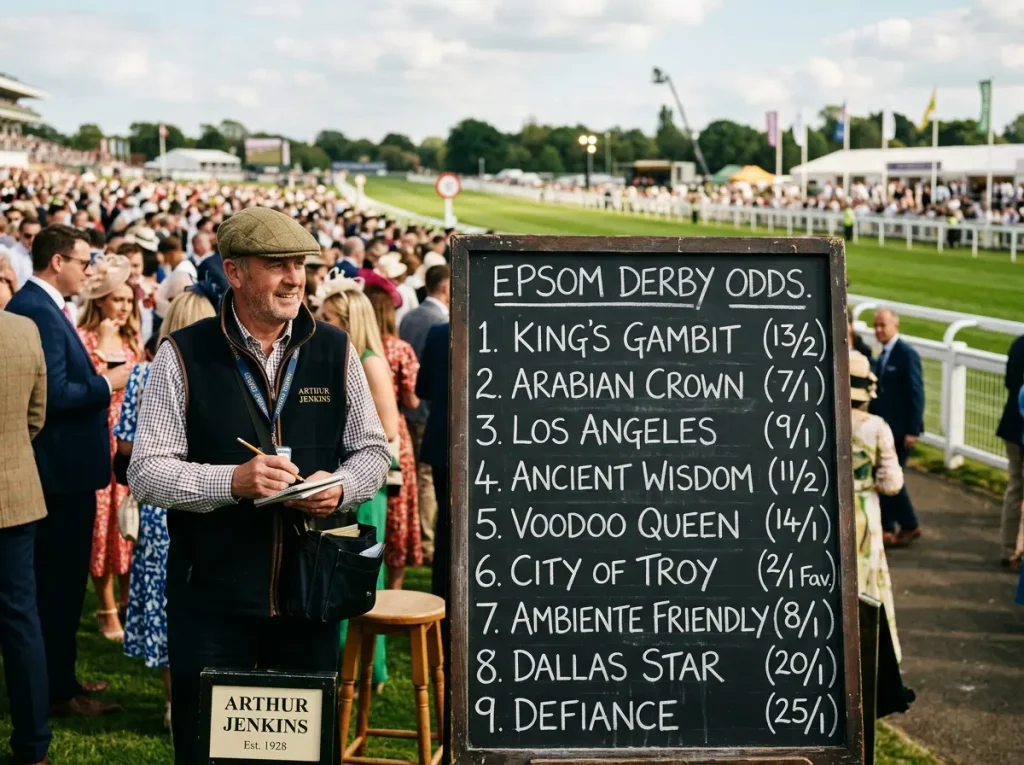
I keep a screenshot from Derby morning 2022 on my phone. It shows the same horse priced at 9/1 with one bookmaker and 14/1 with another. Same horse, same race, same moment in time – a 56% difference in potential return depending on where you placed the bet. That is not an anomaly. It is the norm for the Epsom Derby, where the depth of the ante-post market, the volume of promotional offers, and the range of operator margins create price disparities that would be unthinkable in financial markets.
Comparing odds is the single lowest-effort, highest-impact habit a Derby punter can develop. You do not need to be a form expert or a data analyst. You just need to check more than one price before committing your stake. This guide covers the three odds formats you will encounter, how best odds guaranteed works on Derby day, what market movements tell you about a horse’s real chance, and a systematic method for spotting value before you back any runner.
See also: epsom derby betting for a complete guide to Derby odds.
Fractional, Decimal and Implied: Three Ways to See the Same Price
Walk into any betting shop in Britain on Derby day and the prices are fractional: 5/1, 10/1, 33/1. Open an exchange app and you will see decimals: 6.0, 11.0, 34.0. Pull up a comparison site and implied probabilities appear as percentages. These are three languages describing the same thing, and being fluent in all three makes you a sharper punter.
Fractional odds tell you the profit relative to your stake. At 10/1, you win 10 for every 1 staked, plus your stake back. Decimal odds include the stake in the return: 10/1 fractional equals 11.0 decimal, meaning a 1 bet returns 11 in total. The conversion is straightforward – add 1 to the fractional result. But where fractional odds can obscure comparison (is 11/4 better or worse than 3/1?), decimals make it instant (3.75 versus 4.0 – the 4.0 is bigger).
Implied probability is the format that matters most for value assessment. It answers the question: what chance is the bookmaker giving this horse? The formula: 1 divided by the decimal odds, times 100. A horse at decimal 6.0 (5/1 fractional) has an implied probability of 16.7%. A horse at 11.0 (10/1) sits at 9.1%. When you compare your own assessment of a horse’s winning chance against the implied probability, you are doing the fundamental calculation that separates informed betting from guessing. If you think a horse has a 15% chance of winning and the market implies 9%, the price is offering value. If the market implies 20% and you think it is closer to 12%, the horse is overbet.
I default to decimal odds for comparison and implied probability for value assessment. Fractional odds are ingrained in British racing culture and I use them in conversation, but for the analytical work of comparing prices across bookmakers and calculating whether a bet has positive expected value, decimal and implied are cleaner tools. Most bookmaker apps and websites let you toggle between formats in the settings. Switch to decimal for your Derby research, and save yourself the mental arithmetic of comparing 15/8 with 7/4 when the answer is simply 2.88 versus 2.75.
Best Odds Guaranteed on the Derby: What It Covers and What It Does Not
Best odds guaranteed – BOG – is one of the most valuable promotions in horse racing betting, and on Derby day it can make a material difference to your return. The concept is simple: you take a price on your horse, and if the starting price (SP) is higher than the odds you took, the bookmaker pays you at the better price. You lock in a floor but keep the upside.
The Derby is a race where BOG earns its keep because prices can move significantly between morning and the off. A horse you back at 10/1 at 10am might drift to 14/1 by the time the stalls open if money arrives for a rival. Under BOG terms, you would be paid at 14/1 – the SP – rather than the 10/1 you originally took. That is a 40% boost to your return without any additional stake or risk.
The catches are worth knowing. BOG almost never applies to ante-post bets. The guarantee typically activates only on race-day prices, starting from the morning of the race or, in some cases, from the evening before. If you backed a horse at 20/1 three months ago and the SP is 8/1, you will be paid at 20/1 – your original, better price – but this is not thanks to BOG; it is just the standard terms of your fixed-odds bet. BOG only upgrades your payout when the SP exceeds your taken price, and it only applies within its stated timeframe.
Enhanced odds promotions – those eye-catching offers like “Horse X at 30/1, was 8/1” – are also excluded from BOG at most operators. These are marketing tools priced to attract new accounts, and the inflated odds already exceed any realistic SP. Applying BOG on top would be double-dipping, and bookmakers structure the terms to prevent it.
For a thorough breakdown of how BOG interacts with each-way bets and its specific exclusions, the detailed guide on best odds guaranteed covers the fine print that matters on Derby day. The key takeaway here is that BOG is a genuine edge when used on race-day prices for standard win and each-way bets – and on a day where market movements can be sharp, it provides insurance against taking a price that the market later surpasses.
Market Movers and What Sudden Drift or Contraction Tells You
On the morning of the 2025 Derby, Lambourn shortened from 8/1 overnight to 13/2 at the off. The favourite, Delacroix, was rock solid at the top of the market. The story the market was telling – quiet confidence around the eventual winner, stubborn support for a favourite about to flop – was there for anyone willing to read it. Most people were not reading it. They were looking at the name at the top of the betting and assuming the job was done. After the race, winning jockey Wayne Lordan confirmed what the market had hinted – he knew he had gone a good gallop and his horse had plenty left, a level of confidence that punters tracking the morning move could have inferred from the sustained shortening.
Market movements are information. Not infallible information, but information that reflects the aggregate behaviour of thousands of punters, including the professional layers and backers whose money carries weight. When a horse shortens – when its odds contract – it means more money is being placed on it than the bookmakers expected. When a horse drifts – odds lengthening – it means the money is going elsewhere, or negative information is filtering through.
The useful skill is distinguishing between informed money and noise. A steady, sustained contraction from 12/1 to 8/1 over the course of the morning usually reflects genuine confidence, possibly from connections or professional gamblers who have access to workout reports, stable information, or paddock impressions. A sudden, sharp move from 12/1 to 6/1 in the final fifteen minutes before the off can be speculative – a cascade triggered by a social media tip or a television pundit’s recommendation – and may not carry the same informational weight.
Drift is equally revealing. A horse that drifts from 5/1 to 8/1 without any obvious negative news may be telling you that professional money is actively opposing it – laying it on exchanges or simply not backing it at the current price. This is particularly relevant at the Derby because the market favourite is so often wrong. A drifting favourite is a flag that the smart money does not share the public’s enthusiasm.
I track market movers in the final two hours before the Derby using a combination of odds comparison sites and exchange data. The exchange market is especially useful because it shows the volume of money matched at each price, not just the current odds. A horse whose exchange price has attracted heavy volume as it shortens is a stronger signal than one whose price has moved on thin trading. Volume confirms conviction.
One pattern I have noticed repeatedly at the Derby: when the favourite drifts and two or three horses in the 8/1 to 14/1 range shorten simultaneously, it often signals that professional money is spreading across several alternatives rather than piling into a single replacement. This is different from a market where one horse collapses in price while everything else drifts. The multi-horse shortening pattern tells you the smart money does not have a single answer – it has a shortlist, and the favourite is not on it. In those situations, each-way bets on the shortening group tend to perform well, because the final result frequently comes from within that cluster of second-tier fancies.
Locking in a Price: Morning, Overnight or Ante-Post?
When should you commit? This is the timing question that haunts every Derby punter, and the honest answer is that there is no universally correct moment. But there are principles that tilt the odds of getting a good price in your favour.
Ante-post – months before the race – gives you the widest prices but the highest non-runner risk. Only three of the last ten winners went off as favourite, which means the majority were available at bigger prices early in the ante-post cycle than on the day. The trade-off is clear and well-documented: you accept the chance of losing your stake on a non-runner in exchange for locking in a price that the market may never offer again. The full mechanics and timing strategy are covered in the ante-post betting guide.
Overnight prices – the odds quoted on the evening before the race – sit in a middle ground. The field is confirmed after final declarations on the Thursday. Non-runner risk has largely evaporated. The prices reflect a near-final assessment of the race, adjusted for the going report and any last-minute intelligence. Overnight prices are often where bookmakers set their stall for the next morning, and they can represent good value if the morning market moves against you. BOG covers you if the SP is better, so taking an overnight price with a BOG bookmaker gives you a floor with upside.
Morning prices on Derby day are the last chance to take fixed odds before the SP is determined at the off. These prices are responsive to real-time market flow, paddock reports, and going changes. The advantage is that you have maximum information. The disadvantage is that the bookmaker has maximum information too, and the margins on morning prices are tighter than in the ante-post market. The overround on a sixteen-runner Derby at 10am is typically 115-120%, meaning the bookmaker’s built-in profit is modest, but the prices reflect a more accurate assessment of each horse’s chance.
My approach combines all three. I take a small ante-post position on one or two selections in the spring. I review the overnight prices after declarations and decide whether to add to my positions or take a new fancy. On the morning of the race, I make a final assessment based on market movers, the going, and paddock reports, and place any remaining bets at the best available morning price with BOG protection. This layered approach spreads risk across time and captures value at different stages of the market’s evolution.
Bookmaker Margins on the Derby: How to Calculate the Overround
The overround is the bookmaker’s margin, and understanding it is non-negotiable if you want to compare odds intelligently. It is the difference between a fair book and one that is skimmed against you.
Calculating it takes thirty seconds. Convert every runner’s odds to implied probability, then add them up. In a perfectly fair market, the total would be 100% – every outcome accounted for with no margin. In reality, the total is always above 100%. A typical Derby market on race morning might sum to 117%, meaning the bookmaker has a built-in advantage of 17 percentage points. That margin is distributed unevenly across the field: favourites tend to be priced more accurately (smaller margin), while longshots carry a disproportionate share of the overround.
Online betting turnover on horse racing has fallen by 1.6 billion since 2022, and one consequence of this declining volume is that some bookmakers have widened their margins to protect profitability. A Derby market with a 120% overround is a worse deal for punters than one at 112%. Checking the overround across three or four bookmakers takes minutes and immediately tells you which operator is offering the tightest book.
The exchange market is the benchmark. Exchanges like Betfair typically run at 101-103% because they make money from commission rather than margin. Comparing a bookmaker’s Derby market against the exchange overround tells you how much extra you are paying for the convenience and features (BOG, free bets, cash out) that traditional bookmakers offer. If the gap is small – say 115% versus 102% – the bookmaker’s features may justify the difference. If the gap is large – 130% versus 102% – you are paying a premium that erodes your expected returns on every bet.
The practical discipline is simple: never bet on the Derby without checking at least three prices and mentally noting where the overround sits. The tightest book is not always the best bet – a slightly wider market that offers BOG might deliver better value overall – but knowing the margin gives you the baseline against which every other comparison is made.
A Five-Step Value Check Before You Back Any Derby Runner
Before I back any horse in the Derby – whether ante-post, overnight, or on the morning of the race – I run five checks. They take about ten minutes and have stopped me from making more bad bets than any amount of form study.
First, I calculate the implied probability from the current odds. If a horse is 8/1 (decimal 9.0), the implied probability is 11.1%. I write that number down. Second, I estimate my own probability of the horse winning based on form, pedigree, course suitability, and the trends covered in the statistical analysis. If my number is higher than the implied probability – say 15% versus 11.1% – I have a potential value bet. If it is lower, I move on.
Third, I check three bookmakers and note the best price. A horse at 8/1 with one operator and 10/1 with another changes the implied probability from 11.1% to 9.1%. That difference can flip a bet from marginal to clearly valuable. Fourth, I check the exchange market. If the exchange price is significantly longer than any bookmaker’s price, it suggests the bookmaker is being generous – or that exchange punters know something the bookmakers have not yet priced in. If the exchange is shorter, the bookmaker price includes more margin than usual, and I look for a better option.
Fifth, and this is the check that separates process from impulse: I ask whether this bet fits my staking plan. A horse that passes the first four checks but requires me to exceed my Derby allocation or double up on a sector of the market I am already exposed to is a bet I decline. Discipline is not glamorous. It is profitable.
The average winner’s rating over the last decade sat at 115. When I run my value check, I weight a horse’s rating relative to that benchmark. A runner rated 112 at 14/1 is a stronger value proposition than one rated 105 at the same price, because the first horse is within the proven winning band while the second is below it. The rating does not determine the bet, but it calibrates my probability estimate, which drives the entire value assessment.
This five-step process does not guarantee winners. Nothing does. What it guarantees is that every Derby bet I place has been through a consistent filter that prevents me from betting on sentiment, backing a horse because a pundit recommended it, or chasing a price that looks “big” without asking whether it is big enough relative to the horse’s actual chance. Over nine years of covering UK Classic races, the process has been worth more than any single tip. The complete Epsom Derby betting guide places this value framework alongside the other strategic elements that shape a successful Derby campaign.
See also: Best Odds Guaranteed Derby for more details on this topic.
