
Epsom Derby Winners List: Every Result, Jockey and Trainer Since 2000
 Available in US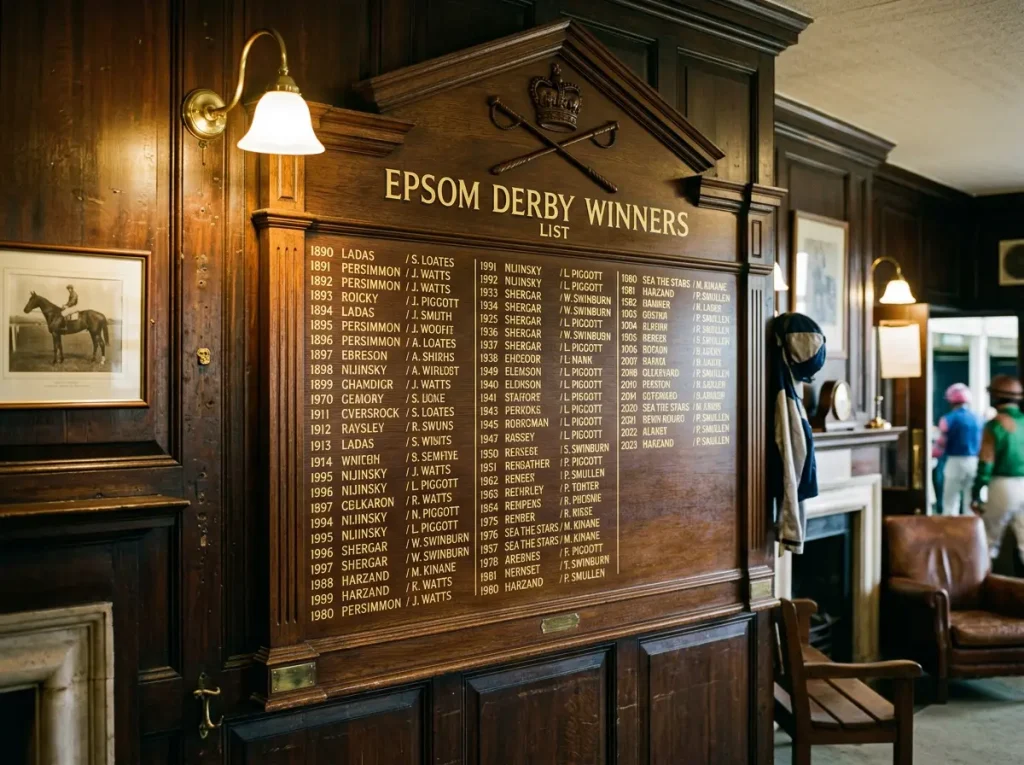
A full results sheet tells you more about the Derby than any preview ever could. Scan through the winners from the past 25 years and patterns leap off the page – certain trainers appearing again and again, certain jockeys riding at their peak, favourite after favourite failing to deliver. This is the raw material that every serious Derby punter should have at their fingertips, not as an exercise in nostalgia but as a tool for the next running.
What follows is every Derby winner since 2000, grouped by decade, with the details that matter most for betting: starting price, winning distance, jockey, trainer, and the context that the bare facts cannot capture. Aidan O’Brien’s 11 victories dominate the modern record, but the full picture reveals far more than a single stable’s supremacy.
See also: epsom derby betting for the full list of past winners.
The 2020s: Ballydoyle’s Hat-Trick and a Covid Derby
The decade opened with a Derby unlike any other. In 2020, the race was moved from its traditional June slot to July, staged behind closed doors at Epsom with zero spectators, and the prize fund dropped to 500,000 pounds – a fraction of its usual purse. Serpentine, trained by O’Brien and ridden by Emmet McNamara, made all the running at 25/1 and won by five and a half lengths. It remains one of the most extraordinary front-running performances in Derby history, delivered in front of empty grandstands.
Adayar won in 2021 for Charlie Appleby at 16/1, and Desert Crown gave Sir Michael Stoute an emotional victory in 2022 at 5/2. Then came Ballydoyle’s hat-trick: Auguste Rodin in 2023 at 11/4, City of Troy in 2024 at 3/1, and Lambourn in 2025 at 13/2, making history as O’Brien became the first trainer to win three consecutive Derbys since the 18th century. The prize money across these years tells its own story – from the pandemic low of 500,000 pounds to 1.5 million in 2023, then 1.556 million in 2024, and now two million pounds confirmed for 2026.
What stands out from the 2020s is the range of starting prices. Only one winner – Desert Crown at 5/2 – could be called a short-priced favourite. Serpentine at 25/1 and Adayar at 16/1 reinforced the Derby’s reputation as a race that routinely punishes favourite backers.
The 2010s: New Stars, New Trainers, Same Challenge
The 2010s produced a wider spread of winning trainers than any recent decade. John Gosden won with Golden Horn in 2015. Dermot Weld took the race with Harzand in 2016. Masar gave Charlie Appleby and Godolphin their first Derby in 2018. Anthony Van Dyck restored O’Brien’s authority in 2019. Between them, six different trainers won the Derby across the decade.
Starting prices ranged from 4/1 (Camelot in 2012) to 40/1 (Wings of Eagles in 2017). The Wings of Eagles result remains the most dramatic outcome of the modern era – a horse hardly mentioned in previews, ridden by Padraig Beggy at enormous odds, trained by O’Brien in a year when the stable had stronger-fancied entries. It was a reminder that the Derby’s unique demands can elevate unexpected horses and expose hyped ones.
Jockey bookings across the decade shifted power. Frankie Dettori, one of racing’s biggest names, never won the Derby during the 2010s. Ryan Moore won it twice. William Buick emerged as a major force with Masar. The lesson for punters was clear: reputation counts for less than tactical aptitude at Epsom. A jockey who rides the track well – handling the camber, timing the challenge down the hill, staying balanced around Tattenham Corner – holds a genuine edge over a more famous rival who fights the terrain.
The 2000s: From Galileo to Workforce
Galileo’s 2001 victory in front of more than 50,000 spectators – the highest Derby attendance of the 21st century – set the template for the modern era. Trained by O’Brien, ridden by Mick Kinane, he won by three and a half lengths and went on to become the most influential stallion of his generation. Every O’Brien Derby winner since carries echoes of that afternoon.
The 2000s also introduced punters to the volatility that would define the race going forward. Kris Kin won at 6/1 in 2003. North Light at 7/2 in 2004. Sir Percy at 6/1 in 2006. Authorized at 5/4 in 2007 was one of the shortest-priced winners of the century, a rare case of the market getting it emphatically right. But then New Approach won at 5/1 in 2008, Pour Moi at 4/1 in 2011, and Workforce at 6/1 in 2010 after setting a new course record that still stands.
Across the full decade, the favourite won just three times out of ten runnings. That 30% strike rate has held remarkably steady through all three decades of the 21st century, making it one of the most consistent and actionable trends in Derby betting.
Patterns the Full List Reveals for Future Bettors
Line up all 25 winners since 2000 and several patterns emerge that are too consistent to be coincidence. Every single winner was a colt – no filly has won the Derby since Fifinella in 1916, and no filly has even run in the race since Cape Verdi in 1998. While the entry conditions do not exclude fillies, the practical reality is that the Oaks, run the day before, serves as the fillies’ equivalent, and trainers direct their best three-year-old fillies there instead.
See also: Epsom Derby History with additional insights and data.
The trainer concentration is equally striking. O’Brien accounts for 11 of the 25 winners. Charlie Appleby has two. John Gosden has two. No other trainer has won more than once since 2000. If you are backing a trainer with no previous Derby-winning experience, you are backing against the weight of history – not impossible, but requiring a specific set of circumstances to overcome the institutional advantage held by operations that have done it before.
Starting prices across all 25 winners average out at around 8/1 to 10/1, with the majority falling between 3/1 and 16/1. Only two winners – Wings of Eagles at 40/1 and Serpentine at 25/1 – came from completely outside the market’s radar. The Derby produces surprises, but they are typically surprises from the second or third tier of the market, not from the rank outsiders. That distinction matters when you are building your shortlist for the next running. A thorough breakdown of how these patterns translate into actionable filters is available in the trends and statistics analysis.
